
Best Bengali Caterers in Kolkata: Authentic Wedding Food, Full Menus & How to Book
Ask any seasoned Kolkata wedding planner what guests remember most after the ceremony, and the answer is almost always the same: the food. Not the flowers, not the lighting, not even the wedding attire. At a Bengali wedding, food isn’t a logistical checkbox — it’s a cultural centrepiece, woven into ritual, family pride, and the collective memory of the event. The best Bengali caterers in Kolkata understand this. They don’t just cook food in large quantities; they curate an experience that starts with the first bite of Luchi and ends with a proper Rosogolla that nobody has to queue twice for.
This guide covers everything a Kolkata family genuinely needs before booking Bengali caterers in Kolkata: the dishes that cannot be skipped, how a full Bengali wedding menu flows course by course, where modern catering is evolving, what to look for in an authentic provider, price benchmarks for 2026, and the answers to the questions most families ask too late — after they’ve already signed.
Asparagus Catering Unit has served Bengali weddings and family celebrations across Kolkata since 2008. The insights here are grounded in that operational experience across thousands of events, not generic catering advice lifted from a different market.
Why Bengali Cuisine Anchors Kolkata Weddings
Bengali cuisine isn’t one thing. It’s a highly regional, occasion-sensitive food culture with its own rules about what gets cooked when, what order dishes appear in, and which preparations carry ritual significance versus which are simply crowd-pleasers. For a Bengali wedding specifically, the food menu has to satisfy all of these layers simultaneously — and that’s precisely why it’s difficult to hand off to a caterer who doesn’t have deep fluency with the cuisine.
The significance starts before the feast itself. In traditional Bengali weddings, certain items — typically banana leaf service for the bride and groom, specific sweets tied to the phoolsajja or bou bhaat ceremony — are tied directly to ritual, not preference. Getting these wrong, or missing them, isn’t just a food quality issue: it’s a cultural omission that families notice and remember.
Beyond ritual, Bengali food also carries a specific expectation of freshness, particularly around fish. Kolkata sits in a river delta with some of the best freshwater fish in India, and a guest at a Bengali wedding will notice the difference between Ilish sourced the same day from the local bazar and a pre-frozen substitute immediately. This freshness standard is one of the hardest things for non-Bengali catering providers to replicate reliably, and it’s one of the clearest markers separating authentic Bengali catering from generalist caterers who’ve added a Bengali menu to their portfolio.
The cuisine also places unusual demands on cooking technique. Kosha Mangsho, for instance, requires sustained low-heat cooking with precise layering of spices — shortcuts produce a technically similar dish that any experienced Bengali palate will identify as inferior within a few bites. Illish Bhapa, traditionally steamed in banana leaf, requires timing and temperature control that doesn’t scale well without dedicated kitchen infrastructure. These aren’t dishes you can batch-cook quickly. They require a kitchen team that has made them hundreds of times and knows exactly where each one can go wrong.
This is the core reason why the best Bengali caterers in Kolkata occupy a specific and difficult-to-fake position in the market. The cuisine rewards fluency, punishes shortcuts, and is evaluated by guests who often cook it themselves.
Core Dishes: The Bengali Wedding Menu Non-Negotiables
Every Bengali wedding menu will vary based on budget, guest count, and family preference, but three dishes consistently define what “authentic Bengali catering” means to guests, regardless of any other variable. If a caterer cannot execute these three with confidence, the rest of the menu becomes a secondary concern.
Kosha Mangsho — The Centrepiece of Bengali Non-Vegetarian Catering
Kosha Mangsho is slow-cooked mutton in a dark, intensely reduced gravy built from mustard oil, caramelised onion, ginger, garlic, and whole spices. The word ‘kosha’ literally means ‘slow-fried’ — it describes the technique of cooking the meat on low heat until the gravy is dense, nearly dry, and clinging tightly to each piece of mutton.
At a Bengali wedding, the quality of the Kosha Mangsho is the most discussed dish by far among adult male guests, and frequently among the family elders who will provide the longest-lasting verdict on whether the caterer was good or not. The texture of the mutton (tender but not falling apart), the depth of the gravy (rich without being oily), and the balance of spices (present but not medicinal) are all evaluated consciously or not by every experienced Bengali palate at the table.
For caterers serving 300 or more guests, Kosha Mangsho presents a genuine execution challenge because the slow-cooking process doesn’t compress well. A caterer who cooks it in large vats at high heat to hit a deadline will produce a version that looks similar but lacks the characteristic depth. Ask any prospective caterer directly: how long do they cook the mangsho, and at what heat? A confident, specific answer is a good sign. A vague one is worth following up on.
Ilish Bhapa — The Ritual Fish Dish of Bengali Weddings
Ilish (Hilsa) is to Bengali food culture what black truffle is to French cuisine: a seasonal, prized ingredient with cultural significance far beyond its role as protein. Ilish Bhapa — Hilsa steamed in a mustard and green chilli paste, traditionally in banana leaf — is the most ceremony-appropriate preparation and the most technically demanding for catering at scale.
The quality of the dish begins and ends with the fish itself. Hilsa caught in the Padma or the Hooghly has a fat content and flesh texture that’s genuinely different from river Hilsa from further south or west, and a knowledgeable caterer will source accordingly. For a Bengali wedding food menu to be taken seriously by the families involved, the Ilish has to be visibly fresh, properly sized, and not substituted for a lesser variety when fresh Ilish isn’t available on the day — which is a real operational risk during the off-season for Hilsa fishing (roughly March through June).
A good caterer will flag this sourcing constraint upfront if your wedding falls outside peak Hilsa season, and will offer a credible alternative preparation (Ilish Shorshe, for instance) rather than quietly substituting a lower-quality fish and hoping nobody notices. Nobody’s said anything to the caterer. Plenty have said something to the family later.
Chingri Malaikari — Prawns in Coconut Cream Gravy
Chingri Malaikari — large prawns cooked in a rich coconut milk gravy with mild spicing — is the third cornerstone of any credible Bengali catering menu for a wedding or formal celebration. It’s a relatively mild dish by Bengali standards (the coconut milk tempers the heat), which makes it one of the most universally appreciated items on the table, including among guests less accustomed to mustard-heavy Bengali cooking.
The prawn size matters here more than any other variable. Chingri Malaikari at a wedding should use golda chingri (freshwater tiger prawns), not the smaller bagda variety — and definitely not shrimp. A caterer who delivers the dish with small prawns has either cut a cost corner or misunderstood the dish. At the right specification, Chingri Malaikari is the dish that converts non-Bengali guests into temporary enthusiasts for Bengali catering generally.
Collectively, these three dishes define the benchmark for any caterer presenting themselves as authentic Bengali caterers in Kolkata. They require sourcing discipline, cooking technique, and operational honesty about seasonal constraints — qualities that separate a genuinely specialist provider from one that has simply listed Bengali dishes on an otherwise generic menu.
Structuring a Full Bengali Wedding Menu (Course by Course)
A proper Bengali wedding menu isn’t a buffet where every dish appears simultaneously. It has a sequence — a logic to the order in which food is served — that reflects both culinary tradition and practical function. Understanding this structure helps families verify that a caterer actually knows what they’re doing, rather than simply producing a long list of Bengali dish names.
The Welcome Layer: Pre-Meal Starters and Reception Food
As guests arrive at a Bengali wedding reception, the pre-meal period is typically handled with light starters: Beguni (battered and fried aubergine), Aloo Bhajas, fish fries (in the Kolkata tradition: basa or bhetki coated in a semolina crust, pan-fried or deep-fried), and Jhalmuri for an informal outdoor setting. These serve the practical function of keeping guests comfortable while the main service is being finalised, and the cultural function of immediately establishing that this is a proper Kolkata celebration, not a generic Indian wedding banquet.
The fish fry is worth noting separately. A properly made Kolkata-style fish fry — using fresh bhetki or similar white fish, marinated correctly, fried to a light golden rather than heavily battered — is one of those dishes that sets an immediate tone. It’s often the first thing guests eat and the first signal about whether the caterer actually knows the cuisine.
The Ritual Opening: Luchi and Dal
Traditionally, the meal itself begins with Luchi — deep-fried puffed flatbreads — served alongside Chholar Dal (Bengal gram cooked with coconut and mild spicing) or Alur Dom (a spiced potato preparation). This opening course is both ritual and practical: it establishes the meal as Bengali, gives guests a foundation before heavier dishes, and creates the structural contrast that makes the fish and meat courses that follow feel like a progression rather than a pile-on.
The Luchi-Dal combination is also the first vegetarian course in a menu that’s largely non-vegetarian, making it important for guests who don’t eat fish or meat. A caterer who rushes past this course or eliminates it in favour of starting directly with the main proteins has misunderstood the structure of the menu they’re supposed to be delivering.
The Fish Courses
Fish is served before meat in the traditional Bengali wedding sequence — a custom that surprises non-Bengali guests accustomed to the reverse logic of most Indian cuisines, where heavier proteins come later. The progression typically runs from lighter, more delicately spiced preparations toward the richer, more intensely flavoured ones:
- Shorshe Ilish (Hilsa in mustard gravy) or Ilish Bhapa as the prestige fish dish
- Chingri Malaikari (prawns in coconut cream)
- Doi Machh (fish in yoghurt gravy) or Macher Jhol (fish in a lighter, everyday-style gravy) as the more accessible fish course
For larger guest counts, three fish preparations may be condensed to two — typically the Ilish preparation plus the Chingri Malaikari — but dropping both and substituting a single generic fish curry is a shortcut that experienced Bengali guests will notice.
The Meat Course
Following the fish comes the meat: Kosha Mangsho as the primary offering, often accompanied by Chicken preparations (usually a mildly spiced Chicken Curry rather than anything too assertive, since the Kosha Mangsho is the main event). At a higher-budget wedding, Mutton Biryani may appear as a separate course or as an optional parallel line alongside the Kosha Mangsho and rice.
At this stage of a large Bengali wedding, service management matters enormously. The Kosha Mangsho needs to come out at the right temperature, with sufficient quantity reserved so that late arrivals to the buffet aren’t faced with a depleted pot. This is a logistics problem more than a cooking problem, but it separates caterers who have planned properly from those who haven’t.
Rice, Accompaniments, and Chutneys
Rice — typically Gobindobhog for traditional families, or Basmati for a more contemporary presentation — accompanies the fish and meat courses. The accompaniments layer is where a Bengali wedding menu reveals its quality through small details: Ghee rice, Papad, various Bengali Achar (pickles), and Tomato Chutney as a palate-cleanser transitioning toward the dessert course.
The chutney course is structurally important. In the traditional Bengali wedding meal, Tomato or Aam Chutney marks the boundary between the savoury courses and the sweets — a signal to the palate and to the service team. Caterers who’ve internalised the menu structure serve it at the right moment; those operating from a generic multi-cuisine playbook sometimes lose track of it entirely.
The Sweets: Where Bengali Catering Ends on a High
Bengali cuisine produces some of India’s most technically demanding sweets — Rosogolla, Sandesh, Mishti Doi, Pantua, Rajbhog — and the dessert course at a wedding is evaluated with nearly as much seriousness as the main fish and meat dishes. A proper Bengali catering menu for a wedding should feature at minimum:
- Rosogolla: soft, spongy, the standard against which every Bengali caterer is implicitly benchmarked
- Sandesh: the dry sweet, available in plain or flavoured varieties (nolen gur in winter, mango or fruit varieties in summer)
- Mishti Doi: set yogurt sweetened with jaggery or sugar — the specific finish to a Bengali meal
Payesh (rice pudding cooked with milk and sugar or jaggery) is often added as a fourth sweet for formal wedding settings and is considered particularly auspicious.
Full Bengali Wedding Menu — Course Overview
| Course | Key Dishes | Notes |
| Pre-meal / Welcome | Beguni, Jhalmuri, Fish Fry, Aloo Bhaja | Light, informal — sets the Kolkata tone immediately |
| Opening (Vegetarian) | Luchi, Chholar Dal, Alur Dom | Ritual opening; important vegetarian anchor |
| Fish 1 (Prestige) | Ilish Bhapa or Shorshe Ilish | Non-negotiable for a full Bengali wedding |
| Fish 2 | Chingri Malaikari | The most universally popular fish course |
| Fish 3 (Optional) | Doi Machh or Macher Jhol | Common at higher-budget events; skippable at mid-range |
| Meat | Kosha Mangsho + Chicken Curry (optional Biryani) | Kosha Mangsho is the primary meat dish |
| Rice & Accompaniments | Gobindobhog/Basmati Rice, Ghee, Papad, Achar | Served through the fish and meat courses |
| Chutney (Palate Cleanser) | Tomato or Aam Chutney | Marks the transition to dessert |
| Sweets | Rosogolla, Sandesh, Mishti Doi, Payesh | Rosogolla and Mishti Doi are non-negotiable |
Modern Twists on Traditional Bengali Catering
The Bengali wedding catering market in Kolkata has changed meaningfully over the past decade. Families who grew up eating entirely traditional menus are now planning weddings where a significant share of guests have different expectations — younger guests accustomed to fusion food, non-Bengali in-laws or business contacts, and the Instagram-native generation that’s as interested in how food is presented as in how it tastes. The best Bengali caterers in Kolkata have adapted to this without abandoning the foundations.
Fusion Bengali Live Counters
Live counters have become one of the most visible changes to the modern Bengali wedding format. Rather than the traditional all-at-once buffet, weddings increasingly feature separate live stations where food is prepared or finished to order in front of guests. Common Bengali-fusion live counter formats include:
- Kolkata Biryani Counter: Kolkata-style biryani (with the characteristic potato and subtle rose water notes) plated fresh from a large handi
- Kosha Mangsho Wrap Counter: the traditional mutton preparation served in a paratha or roomali roti wrap for a contemporary format
- Fish Fry Live Station: bhetki or basa fillets fried to order, with dipping chutneys, rather than pre-fried and held in chafing dishes
- Mishti Counter: a display of Bengali sweets with a live Jilapi or Gulab Jamun frying element for visual engagement
Live counters solve a genuine quality problem: dishes like fish fry and certain fried items genuinely taste better finished to order than held in chafing dishes for an extended service window. They also create a visual energy point on the wedding floor that guests naturally gravitate toward.
Vegetarian Bengali Menus for Mixed Guest Lists
The rise of mixed-community weddings and the growing number of strictly vegetarian guests has pushed the best Bengali caterers to develop genuinely complete vegetarian Bengali menus, not just a stripped-down version of the non-vegetarian offering. A properly developed vegetarian Bengali catering menu might include:
- Shukto: a traditional Bengali dish of mixed vegetables in a bitter-sweet sauce — one of the most distinctively Bengali vegetarian preparations
- Aloo Posto: potato with poppy seed paste — deceptively simple, technically precise, and immediately recognizable to any Bengali guest
- Cholar Dal with Narikel: Bengal gram with coconut, mildly sweet and aromatic
- Paneer-based preparations as the protein anchor for non-fish, non-meat guests
- Full Bengali sweet course as described above
A caterer who can deliver this menu at the same quality standard as the non-vegetarian offering — rather than treating the vegetarian course as an afterthought — is one who’s genuinely equipped to handle the full range of a modern Kolkata wedding guest list.
Contemporary Presentation at Bengali Weddings
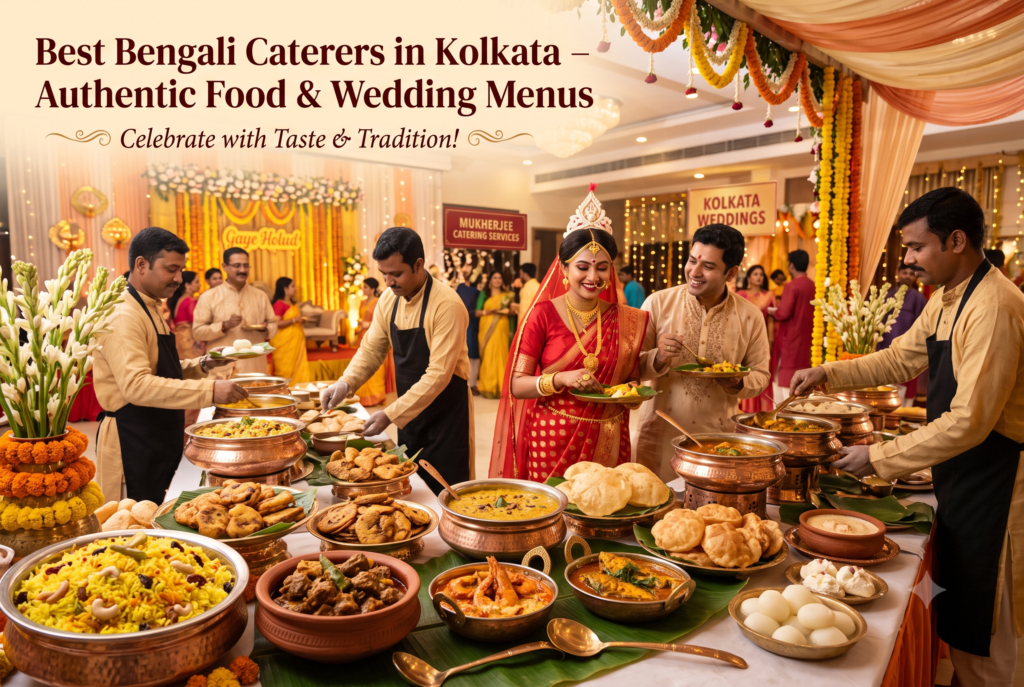
Presentation is the third area of visible evolution. Traditional banana-leaf service — where food is served in small portions directly onto a banana leaf or in small clay containers — has seen a revival at premium Bengali weddings, largely because it photographs well and connects the modern event to a tangible cultural tradition. Alongside this, the shift from stainless steel chafing dishes to copper or clay serving vessels for the buffet line is becoming more common among higher-end Bengali catering providers.
None of these presentational choices changes the fundamentals of what makes a good Bengali wedding menu: the sourcing discipline, the cooking technique, and the structural sequence of the meal. But they do matter to families planning their event for a mixed or contemporary guest list, and they’re worth asking about when comparing caterers.
How to Pick an Authentic Bengali Caterer in Kolkata
The Bengali catering market in Kolkata ranges from genuinely specialist providers who have spent years developing deep expertise in the cuisine to multi-cuisine caterers who have added a Bengali section to their menu without the underlying kitchen capability to execute it consistently. Here’s how to tell the difference before you’ve committed a deposit.
Ask About Specific Sourcing Practices
The most reliable signal of a genuinely specialist Bengali caterer is their answer to questions about sourcing. Ask directly: where do they buy their Ilish from, and what do they serve if fresh Hilsa isn’t available? How do they source their chingri (prawns) and what size are they committing to for the Chingri Malaikari? Which variety of rice do they use for Gobindobhog preparations?
A caterer who answers these questions specifically and immediately — with an explanation of what they do differently in different seasons — knows the cuisine operationally. One who gives a vague answer about using “fresh, quality ingredients” is likely not thinking about the cuisine at this level of detail. For a caterer whose selling point is authenticity, vague answers about sourcing are a significant red flag.
Request a Bengali-Specific Tasting
Any serious caterer will offer a tasting before you confirm a booking. For Bengali catering specifically, ask that the tasting includes the three benchmark dishes: Kosha Mangsho, Ilish preparation (or a comparable fish dish if Hilsa is out of season), and Chingri Malaikari. These are the dishes that reveal the most about a caterer’s cooking capability — they’re also the ones least likely to be dressed up for a tasting if the day-to-day standard isn’t there.
You can also read the menu range and check reviews from past Bengali wedding clients to validate what you’re seeing in the tasting against what the caterer has actually delivered at scale.
Check Experience With Your Guest Count and Venue Type
A caterer who executes beautifully for 80 guests at an intimate reception may not have the logistics in place for 400 at a large community hall. Ask specifically whether they’ve catered Bengali weddings of a similar guest count at a similar venue type (outdoor, banquet hall, rooftop) — and whether they can provide references for events at that scale.
This is also the moment to ask about staffing ratios, transport logistics for the food, and how they manage the service timeline on the day. These operational questions are particularly important for Bengali wedding catering where the sequence of the meal (fish before meat, chutney before sweets) requires that the kitchen and service team are working in genuine coordination rather than simply refreshing chafing dishes as they empty.
Verify Reviews Specifically for Bengali Events
A catering company with strong overall reviews may still have a mixed track record specifically for Bengali cuisine if it’s not their primary focus. When reading testimonials or asking for references, filter for reviews that specifically mention Bengali wedding menus, the quality of the Ilish or Kosha Mangsho, or the overall experience of a Bengali family event. Generic praise for ‘great food’ doesn’t tell you whether the Gobindobhog rice was the right variety or the Sandesh was made fresh that morning.
For caterers you’re seriously considering, it’s worth asking the question directly: what percentage of their events are specifically Bengali wedding catering versus other event types? A provider for whom Bengali weddings are the core business is likely to have more accumulated expertise and more robust sourcing relationships than one for whom it’s a supplementary offering.
You can also check the broader guide to choosing a caterer in Kolkata for the standard evaluation checklist (FSSAI licensing, staff ratios, pricing transparency) that applies alongside the Bengali-specific criteria above.
What Does Bengali Catering Cost in Kolkata? (2026 Price Guide)
Bengali catering pricing varies significantly based on menu complexity, guest count, service style, and seasonal demand. The figures below reflect Asparagus Catering Unit’s 2025-26 quote data across Bengali wedding and family events in Kolkata, and are a reliable starting benchmark for comparison.
| Package Type | Approx. Price Per Plate | What’s Typically Included |
| Basic Bengali Vegetarian | ₹350 – ₹550 | Luchi, Dal, Alur Dom, 2 veg mains, Rosogolla, Mishti Doi |
| Standard Bengali Non-Veg (Wedding) | ₹650 – ₹900 | Above + 1 Fish (Ilish or Chingri), Kosha Mangsho, full sweet course |
| Premium Bengali Wedding Menu | ₹900 – ₹1,400 | 3-4 fish courses, Kosha Mangsho + Chicken, live counters, extended sweets |
| Bengali Corporate / Family Event | ₹450 – ₹750 | Simplified Bengali menu; 1-2 fish/meat dishes, standard sweets |
A few cost variables specific to Bengali catering:
- Ilish (Hilsa) pricing is season-sensitive — peak season (monsoon, roughly July-September) typically commands a 20-30% premium over off-season sourcing. A good caterer will flag this proactively.
- Golda chingri (large freshwater prawns) is priced higher than smaller varieties — a Chingri Malaikari with large golda is not the same price as one made with bagda or smaller prawns.
- Live counters add roughly ₹80-₹150 per guest depending on the station type, plus dedicated service staff for each station.
- Gobindobhog rice (the traditional aromatic Bengal variety) costs more than Basmati at wholesale; a caterer using the right variety will reflect this in their quote.
For an accurate quote for your specific event, contact Asparagus Catering Unit directly with your guest count, preferred menu, date, and venue location. All quotes are itemised — you’ll see exactly what you’re paying for rather than a per-plate headline with undisclosed add-ons.
Why Asparagus Catering Unit Is Among the Best Bengali Caterers in Kolkata
Founded by Pritam Datta (IHM Taratala alumni) in 2008, Asparagus Catering Unit has spent 16 years building a specific reputation for authentic Bengali catering in Kolkata: sourcing discipline, traditional cooking technique, and the operational infrastructure to execute correctly at any scale from an intimate family function to a 500-guest wedding reception.
- Bengali cuisine is the primary expertise, not an add-on to a generic multi-cuisine menu
- Full menu range: traditional, fusion, vegetarian, multi-cuisine — with a documented Bengali food specialisation
- Transparent pricing with itemised quotes, not just a per-plate headline number
- IHM Taratala-trained founder who continues to develop the menu through direct culinary research
Asparagus serves families and corporate clients across all major Kolkata districts — from South Kolkata and North Kolkata to Salt Lake, Newtown, and Hooghly.
For Bengali wedding catering specifically, the relevant reference point is the Bengali caterers — and the best next step is a direct conversation about your event, date, and menu requirements.
Frequently Asked Questions: Bengali Caterers in Kolkata
What dishes are a must for a Bengali wedding menu?
The three non-negotiable dishes are Kosha Mangsho (slow-cooked mutton), Ilish Bhapa or Shorshe Ilish (Hilsa fish preparation), and Chingri Malaikari (prawns in coconut cream). The dessert course must include Rosogolla and Mishti Doi at minimum. The meal should begin with Luchi and Chholar Dal as the ritual opening course.
Can Bengali caterers customise the menu for non-Bengali guests?
Yes. The best Bengali caterers in Kolkata routinely serve mixed guest lists and build menus that balance traditional Bengali preparations with more widely accessible dishes. Common approaches include adding multi-cuisine dishes (Chinese, Continental, or North Indian items) as parallel lines, operating live counters with more universally familiar formats (biryani, wraps), and ensuring the vegetarian menu is genuinely complete rather than a token offering. Non-Bengali guests generally find Chingri Malaikari and the sweet course to be the easiest entry points into the cuisine.
What’s the price range for Bengali catering in Kolkata?
For a standard Bengali wedding menu (non-vegetarian, with Ilish and Kosha Mangsho), expect ₹650-₹900 per plate at mid-range. Premium menus with multiple fish courses and live counters typically run ₹900-₹1,400 per plate. Vegetarian Bengali menus start from approximately ₹350-₹550 per plate. Prices vary with guest count, seasonal ingredient costs (particularly Hilsa), service style, and event date — Bengali wedding season (November through February) typically sees higher demand and tighter availability. Get a full itemised quote before committing.
Conclusion
A well-executed Bengali wedding menu is simultaneously one of India’s most celebrated regional cuisines and one of the hardest to deliver well at scale. The three benchmark dishes — Kosha Mangsho, Ilish Bhapa, and Chingri Malaikari — require sourcing discipline and cooking technique that separate genuine specialists from generalist caterers who’ve added Bengali dishes to an otherwise non-specialist menu. The full menu structure, from Luchi to Mishti Doi, has its own internal logic that experienced families will evaluate consciously or not.
When choosing Bengali caterers in Kolkata, the criteria that matter most are sourcing specificity (can they answer concrete questions about where their Ilish and chingri come from?), tasting quality on the three benchmark dishes, evidence of experience at your scale and venue type, and a review history that specifically references Bengali events rather than just generic praise.
If you’re ready to discuss your menu requirements and get an itemised quote, contact the team here, or explore the full Bengali catering menu to see what’s available for your event.